













I have spent two decades helping some of the world's largest enterprises adopt AI. And for most of that time, the pattern was the same: bolt it on, rebrand the org chart, move on.
That worked, for a while. AI was expensive, limited, and hard to deploy. Treating it as an add-on was reasonable because the technology itself was still finding its legs.
That era is over.
Today, the ability to reason, synthesise, analyse, and decide can be embedded into any system at marginal cost. Intelligence is no longer scarce. And when the fundamental input to your business becomes cheap and composable, you don't just upgrade your tools. You redesign the company.
This is what I mean by AI-native. And most people still get it wrong.
A Tool Gets Things Done. A Means Does Things.
The biggest misconception I see in enterprises today is simple: they think AI is a tool.
It isn't. A tool is something you pick up to get a job done- a hammer, a spreadsheet, a chatbot. You use it. You put it down. The way you work stays the same.
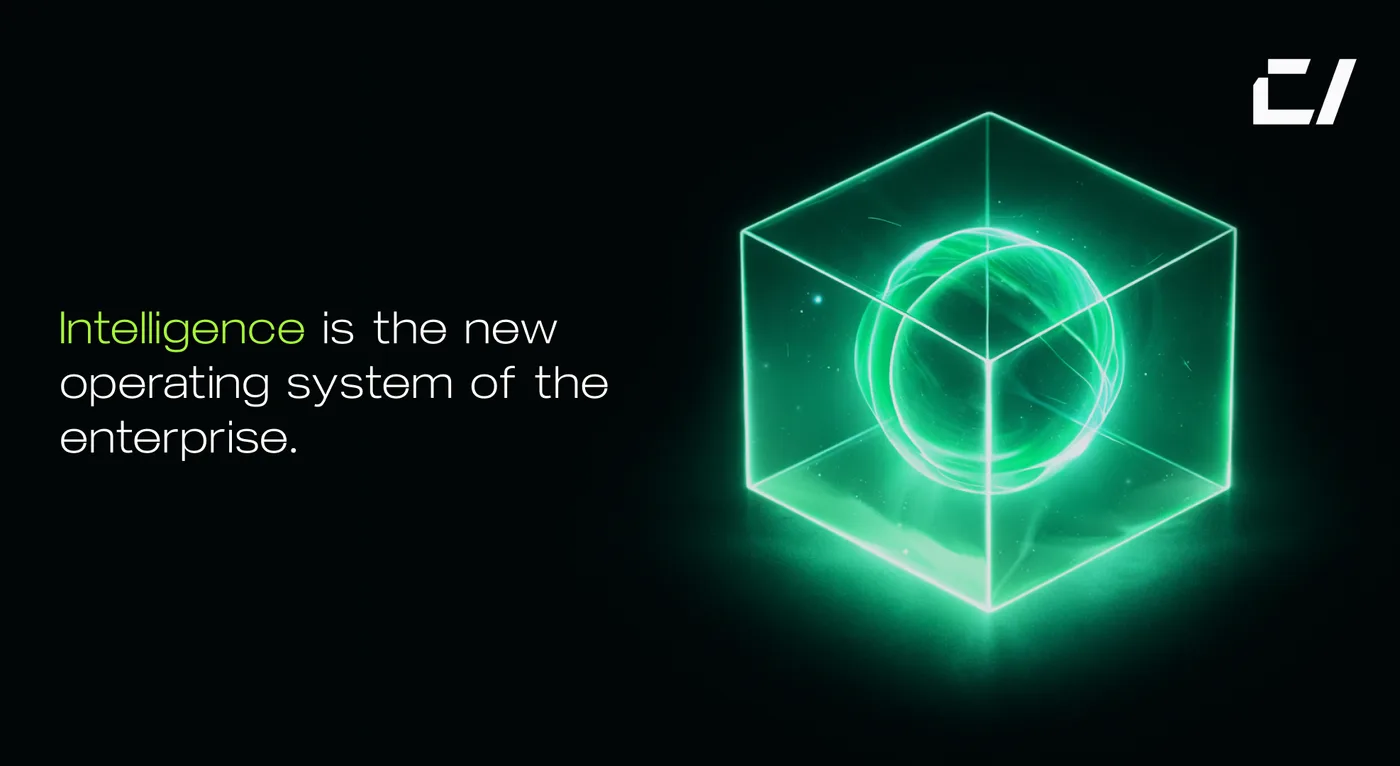
AI-native means something fundamentally different. AI is not a tool you use. It is the means through which the firm operates. It is in every fabric of the company psyche: strategy, building, operations, marketing, governance. It is not an application running on your company. It is the operating system of your company.
Think about what an OS actually does. It manages processes. It allocates resources. It coordinates between systems. It governs what runs, when, and how. That is exactly what AI does in an AI-native firm, not answering questions on the side, but running through every decision, every workflow, every product that ships.
When we built Chartered Vectorial, we did not ask "where can we use AI?" We asked: "what does a firm look like when intelligence is the operating layer beneath everything?"
The answer changed everything, from how we hire, to how we structure the org chart, to what we can promise clients.
The Org Chart Has Agents In It.
Here is the part that makes traditional enterprise leaders uncomfortable.
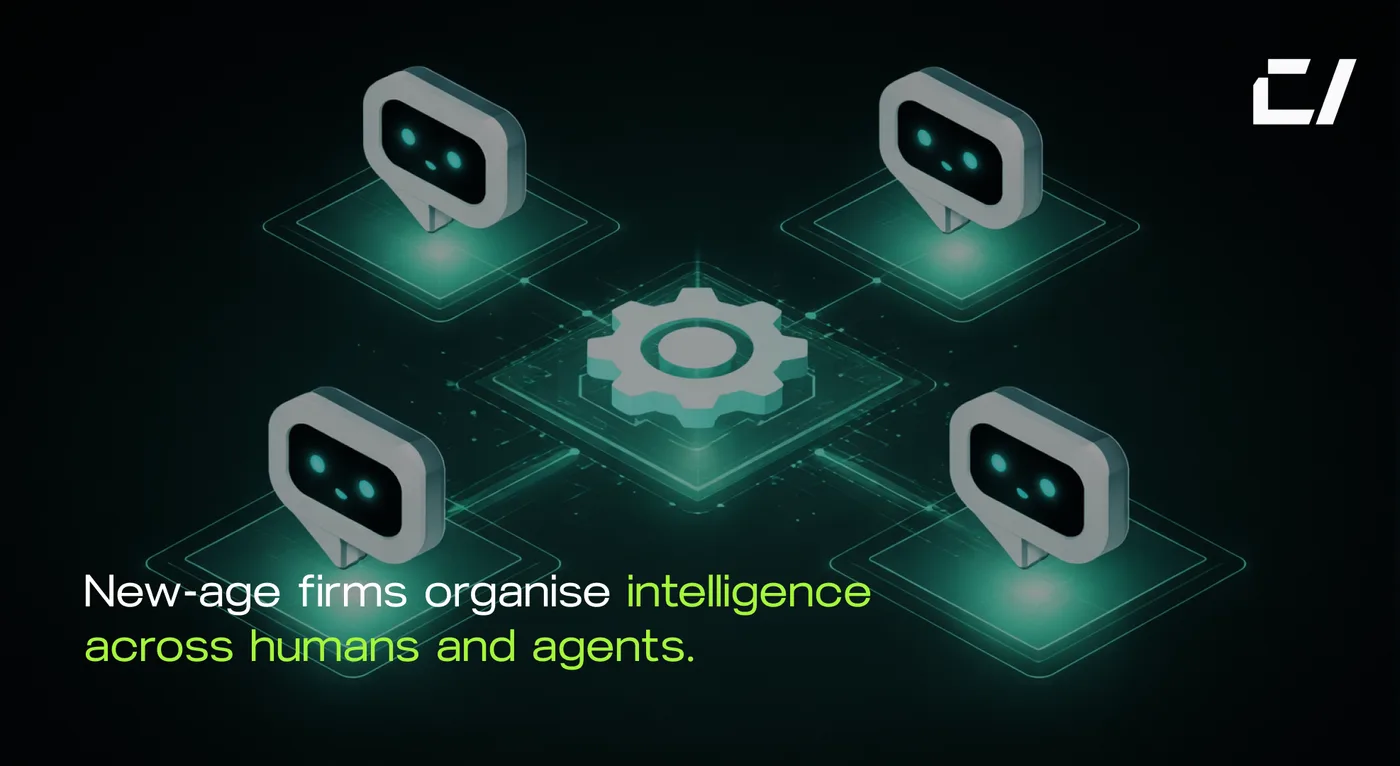
At Chartered Vectorial, our organisational hierarchy includes AI agents. Not as tools underneath human roles. As roles themselves, with responsibilities, outputs, and governance boundaries.
This was a deliberate design choice. We sat down and said: if intelligence is composable, why would we only put humans in the org chart?
The structure is clear. Humans sit at the top. They set direction, make strategic decisions, approve what ships, and govern what the agents do. Agents sit in the middle. They do the analytical heavy lifting- reading, synthesising, debating, reviewing, producing. They operate within boundaries that humans define.
We run agent councils: coordinated groups of specialised AI agents, each responsible for a distinct analytical lens, orchestrated to examine the same problem from multiple perspectives. One focuses on financial analysis. Another on risk. Another on market context. A synthesis agent aggregates their outputs, resolves contradictions, and produces a unified view.
This is not a chatbot. This is an organisational structure where intelligence is distributed across both humans and agents, with structured disagreement built in by design. Quality emerges from collaborative review, not from any single capability, whether human or artificial.
The 1:7 Ratio
At Microsoft, we had a saying: "Do more with less."
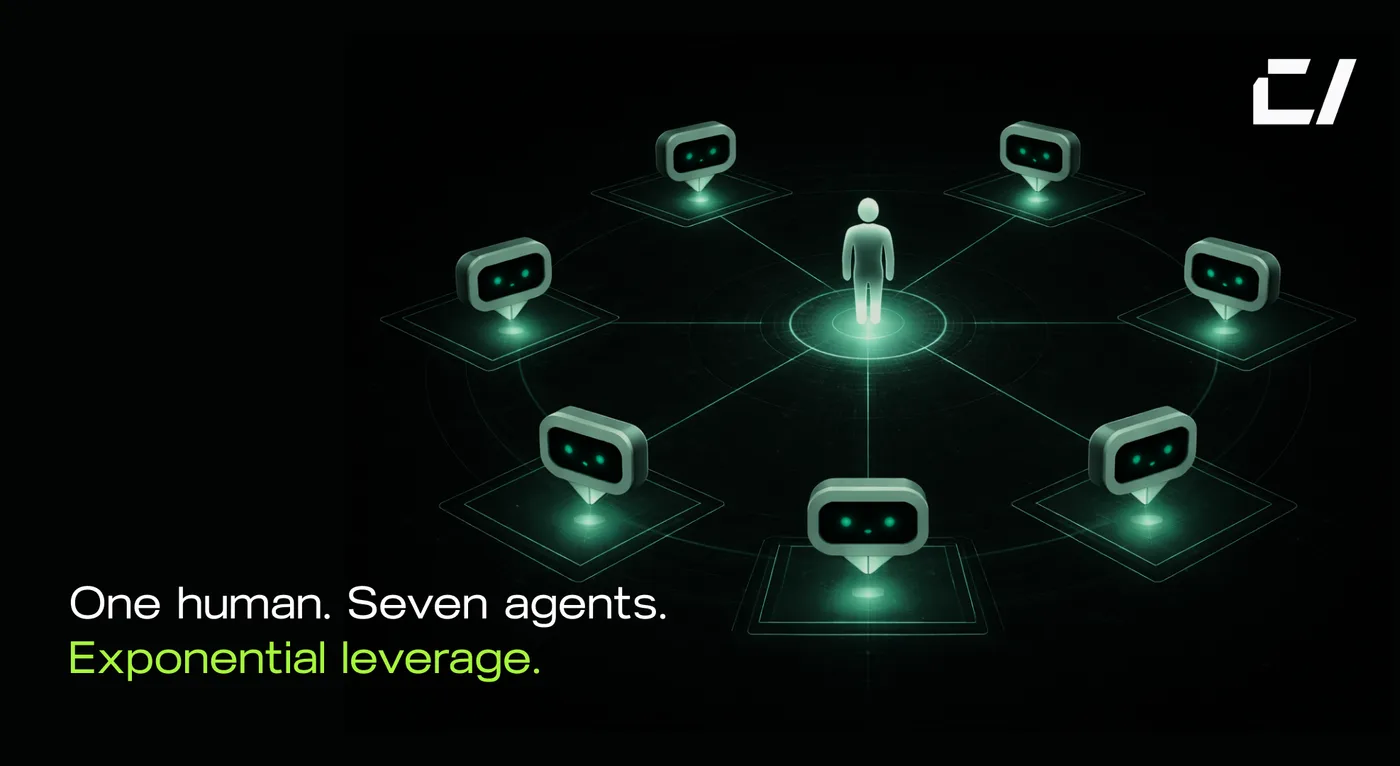
Being AI-native is exactly that, but with a specific ratio we have engineered into how we operate. At Chartered Vectorial, every human works with an average of seven AI agents. 1:7.
Those seven agents are different for every function. An engineer's constellation of agents is not the same as a strategist's. A compliance specialist works with a different set than a product designer. The agents are specialised, configured to the domain, and continuously improving.
What this means in practice is that a small team with the right agent architecture can deliver what would traditionally require an organisation many times its size. We deploy production-grade products in weeks. We maintain multiple product lines simultaneously. We compound intelligence from every engagement.
This is not about replacing humans. It is about extending them. Each person on the team operates with a multiplier that transforms what they can move, how fast they can move it, and how much they can govern at once.
The AI-to-human ratio is not a vanity metric. It is the new unit of enterprise leverage.
Three Tiers, And the Dodo Test
Here is the provocation.
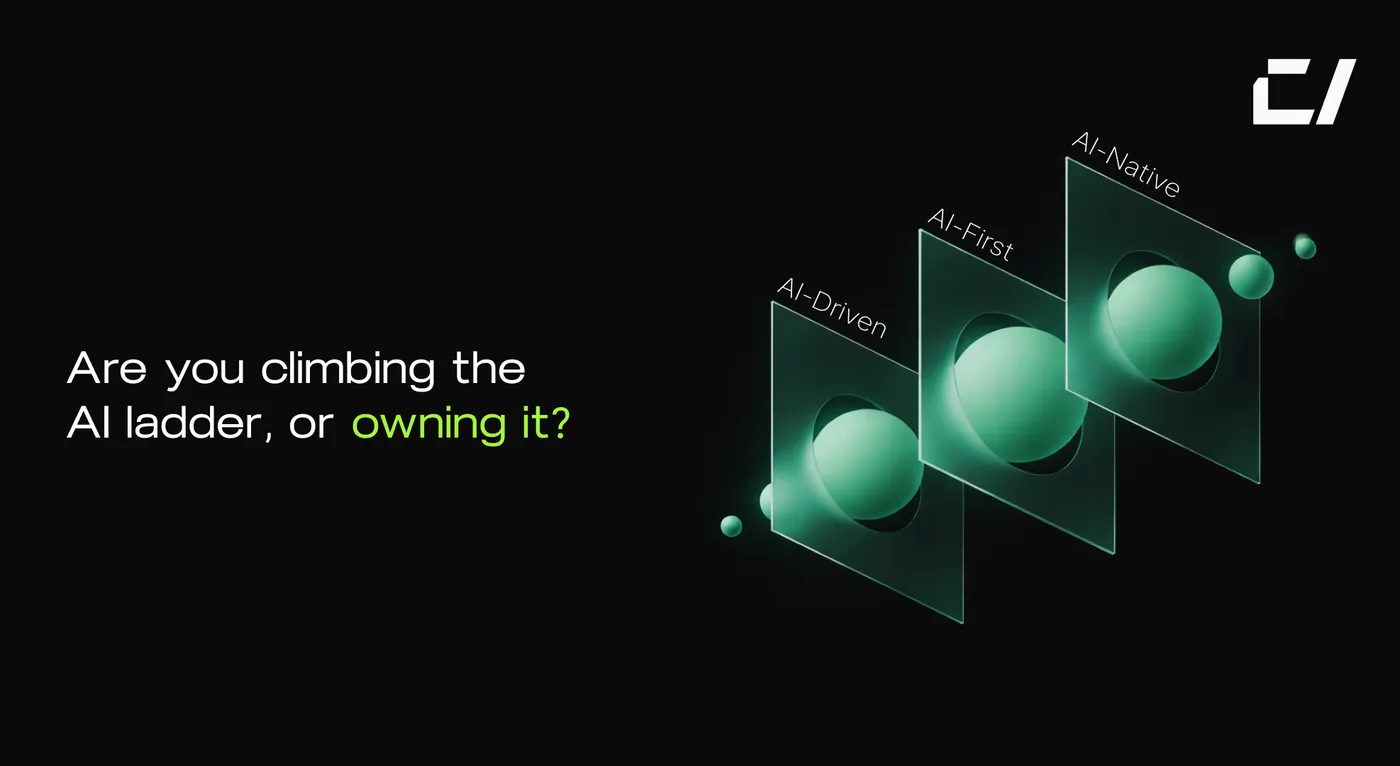
I believe there are three tiers of AI maturity that matter. If your company does not sit in at least one of them, you are on a path to extinction.
Tier 1: AI-Driven. Your decisions are informed by AI. You use machine learning, analytics, and intelligent automation to make better choices. This is table stakes. Most forward-thinking enterprises are here or getting here.
Tier 2: AI-First. You design new products, processes, and strategies with AI as the starting assumption. You do not retrofit intelligence, you begin with it. Your product roadmap assumes AI capabilities. Your hiring plans account for agent leverage. This is where competitive advantage starts to compound.
Tier 3: AI-Native. AI is not a feature, not a strategy, not even a priority. It is the operating system. It is woven into how the firm thinks, builds, ships, and governs. The org chart includes agents. The methodology is agentic. Products are built by agents, reviewed by agents, and governed by humans. This is where the next generation of enterprises will live.
If you are not in any of these tiers, if you are still treating AI as a departmental initiative or an innovation lab experiment, you are the dodo. The market is moving. Intelligence is being commoditised. And the firms that do not restructure around this reality will find themselves outpaced by competitors a fraction of their size.
What the Next Enterprise Looks Like
The hybrid workforce is not a future prediction. It is the present for firms that are paying attention.
In five years, every successful company will have agents alongside humans in its operational structure. Not as experiments. Not as side projects. As first-class participants in how the firm creates value.
The org chart will be hybrid by default. Methodology will be AI-native, agents building agents, with humans governing the gates. Products will ship in weeks because the cognitive load is distributed across human judgment and agent execution. And intelligence will compound: every engagement, every deployment, every client interaction will make the system smarter.
The question for every CEO is not "should we adopt AI?" That question was settled years ago.
The real question is: are you redesigning your firm around intelligence as the operating system, or are you still running applications on an OS built for a world where cognition was scarce?
One path leads to compounding leverage. The other leads to the natural history museum.
Chartered Vectorial is an AI-native Applied Intelligence firm with Consulting DNA, part of the Chartered Group's 35-year legacy of building businesses across Europe and Asia. We ship production-grade AI, configured to your workflows, governed from day one.
Ready to move from insight to production? Get in touch at info@charteredvectorial.ai.