








A few weeks ago, our founder Pradeep Menon sat on a panel with founders and operators who had no patience for abstraction. They wanted to know what is actually working, what is theatre, and what the next two years demand from companies willing to rebuild from the ground up.
What struck him in that room was a pattern hiding beneath every question. Founders caught between two worlds: buying tools to survive today, knowing they need to redesign everything to win tomorrow. The gap between those two choices is where most companies stall.
It is a gap we think about every day.
We built Chartered Vectorial from day one as an AI-native company. Not because it was the trend, but because we believed the firms that would matter in ten years would be the ones that started that way. Seven people. Five product lines. Clients across Singapore, Japan, and Thailand. And a fundamental conviction that intelligence is not a feature you add. It is the operating model you build from.
These are the eight questions from that panel. And how we think about each one.
"When should a founder stop looking for AI tools and start redesigning their entire cost structure around an AI operating system?"
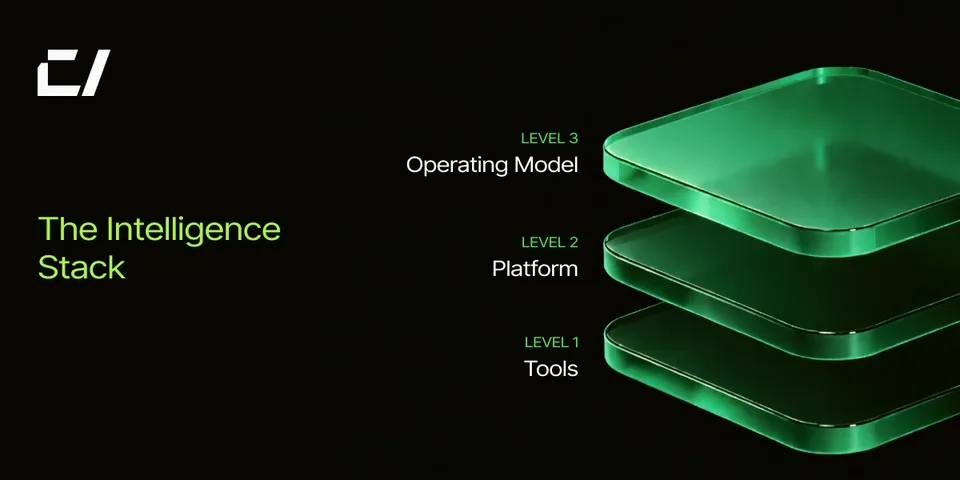
Every company sits somewhere on what we call the Intelligence Stack: three levels, and most are stuck at the first.
Level 1 is Tools. Point solutions for specific problems. Chatbots, copilots, automations. This is where 90 per cent of companies are today. The ROI is incremental. 10 to 20 per cent productivity gains.
Level 2 is Platform. Connecting those tools into shared infrastructure with a common data layer and integrated workflows. The economics start shifting here because intelligence is being amortised across the business instead of paid for per-tool.
Level 3 is Operating Model. Redesigning the entire cost structure around intelligence as infrastructure. This is what we did at Chartered Vectorial from day one. VectorOS treats large language models as the hardware abstraction layer, the Model Context Protocol as the driver model, and Skills as the plugin API. Every product we ship is a native application running on this OS.
The practical trigger for most founders: when tool spend exceeds 15 to 20 per cent of operating costs and workflows are still being stitched together manually, another subscription is not the answer. An operating model is.
Stop asking which AI tool to buy. Ask what the company looks like if thinking costs zero.
"How do you decide what to develop in-house and what to adopt externally, without creating vendor lock-in?"
Every capability a company needs falls into one of two buckets. We call it the Moat or Commodity Test, and the decision is actually simple.
If it differentiates in front of a client, build it. If it is table stakes, integrate it.
At Chartered Vectorial, we built our own MCP ecosystem with over 3,200 skills, our own document intelligence pipeline, our own knowledge graph architecture. Those are where the IP lives. That is the moat. Cloud infrastructure, standard LLM APIs, open-source tooling for everything else. Those are commodity.
Vendor lock-in is a real concern but it is usually misdiagnosed. The risk is not which model provider API is in use. APIs are swappable. The risk is when data architecture becomes inseparable from a vendor's proprietary format. Once knowledge graphs, document schemas, and workflow definitions are tangled into someone else's platform, the company is stuck.
The test: if replacing a vendor would take more than two weeks, the lock-in has already happened. Design for portability from day one.
"Where is automation meaningfully reducing cost, and where is it just creating expensive noise?"
Before automating anything, we run it through what we call the 3E Filter: three questions, in this exact order.
Eliminate first. Should this process exist at all? This is the step most companies skip, and it is where the most expensive noise comes from. Do not automate a bad workflow. Kill it.
Extract second. Can AI extract value that humans currently cannot at scale? This is where real margin expansion happens. Our document intelligence platform collapses what was a five-step pipeline into two steps: extract, then ask. That is not a 20 per cent improvement. That is a 10x reduction in time-to-insight.
Expand third. Can AI enable serving more clients, entering new markets, or creating new offerings without proportional cost increase? Our research intelligence platform produces executive briefings that would take a human team days. Our reconciliation engine automates transaction matching at 80 to 90 per cent auto-match rates.
Where is the expensive noise? Three patterns consistently: automating things that should not exist in the first place, content mills where volume replaces quality, and strategy that produces beautiful decks but ships nothing. That is theatre, not leverage.
"As AI takes over cognitive labour, where does human judgment become more critical?"
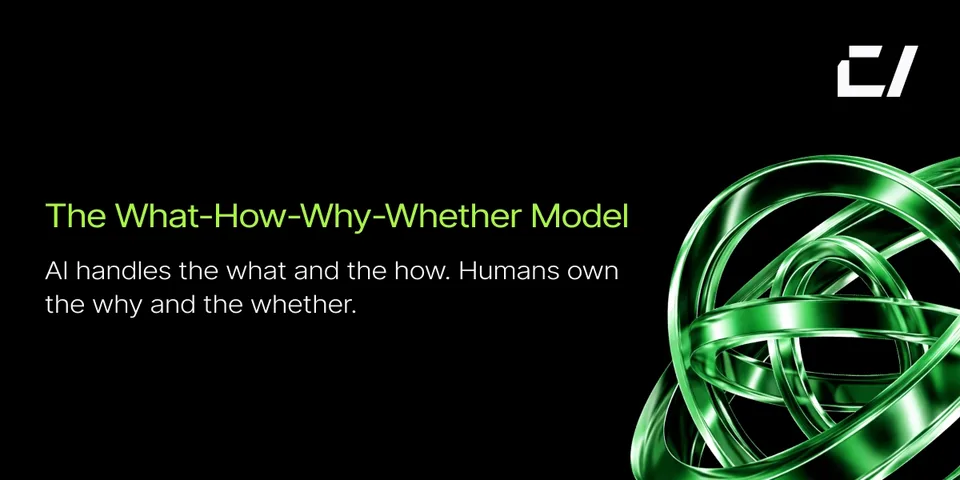
AI and humans are not competing for the same tasks. They operate on completely different planes of decision-making. We think about this through what we call the What-How-Why-Whether Model.
AI owns the what: identifying options, surfacing data, recognising patterns, research synthesis. And AI owns the how: executing, implementing, producing at speed and scale. Code generation, content production, workflow automation. AI is extraordinary at these.
Humans own the why: strategic intent, purpose, values. Which product to build next. Which market to enter. Which client to walk away from. And humans own the whether: should this be done at all? Is the AI output appropriate for this context? Does it respect the client relationship?
We use a Product Potential Score to evaluate every opportunity. Five dimensions, each scored one to five, with a threshold of 15 to proceed. AI can gather all the data for that scoring. But the final call on portfolio fit requires judgment that comes from understanding the business holistically. No model does that.
And when working across cultures, presenting to a Japanese securities firm where hierarchical protocol shapes every interaction, or navigating regulatory nuance in Thailand, no model handles the relational subtlety that determines whether the engagement is won.
AI handles the what and the how. Humans own the why and the whether.
"What are the governance and data ownership risks that founders are currently ignoring?"
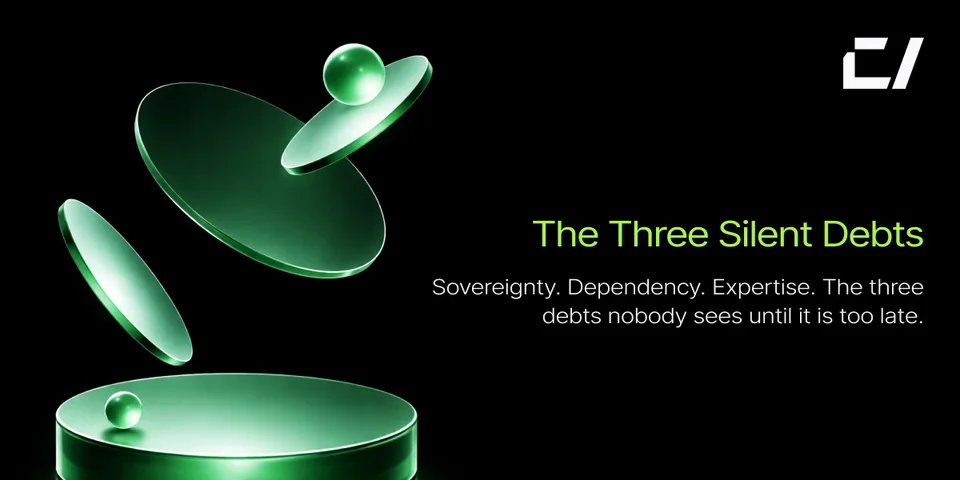
These are what we call the Three Silent Debts: liabilities that do not show up on the balance sheet until they explode.
Sovereignty Debt. Where does client data go? Which jurisdictions does it traverse? In Southeast Asia, where we work across Singapore, Thailand, and Japan, regulatory environments vary dramatically. Most founders pushing client data through third-party AI APIs genuinely do not know the answer. This debt compounds silently until a regulator asks. By then, it is expensive.
Dependency Debt. What happens if the primary model provider changes their API, raises prices, or restricts access? Companies that build entire product lines on a single provider's behaviour with no abstraction layer between them and the model do not have a business. They have a feature on someone else's platform. VectorShield, our five-layer trust architecture, was built specifically because we saw this coming.
Expertise Debt. This is the one nobody talks about. When cognitive work is automated, the training of humans to do it stops. Five years from now, if the AI fails, is there anyone who understands the underlying domain well enough to intervene? The risk nobody talks about: when thinking is automated, the human expertise needed to catch the AI when it is wrong stops being built.
"How do you build a moat when every competitor has access to the same models?"
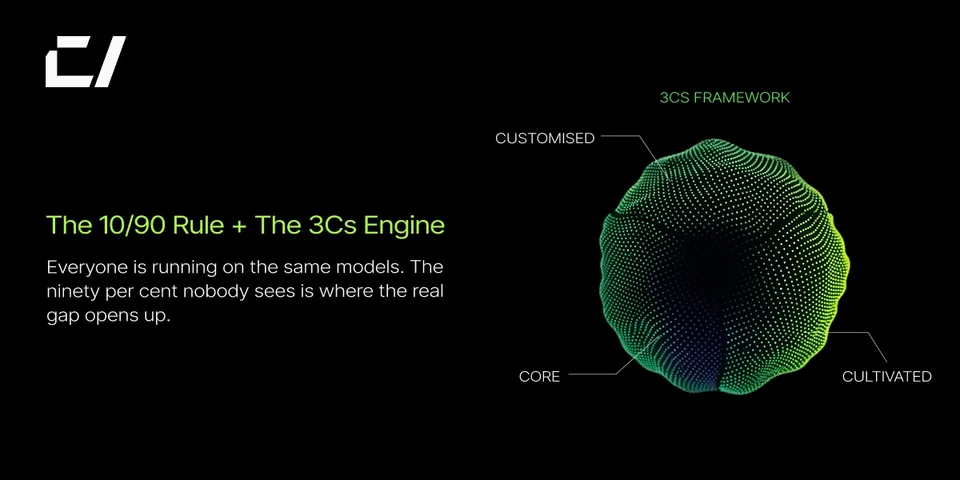
Everyone asks about the model. The model is ten per cent of the value. The other ninety is what nobody sees. We call this the 10/90 Rule.
The ten per cent is commodity. Which LLM is in use. Everyone has access to the same foundation models.
The ninety per cent is where moats live: domain-specific data architecture, workflow integration depth, and deployment velocity. Not everyone has structured years of financial documents into knowledge graphs with domain-specific ontologies. Not everyone has AI configured into a client's actual workflow, their document standards, their compliance requirements, their approval chains.
The moat compounds over time through what we call the 3Cs Engine.
Core: capabilities that ship to every client. The baseline platform.
Customised: configuration adapted to each client's workflow. No two deployments are identical.
Cultivated: innovations discovered at one client feed back into the platform for everyone. One client's edge case becomes another client's standard feature. This is the compounding effect. The moat that gets wider over time, not narrower.
Everyone is running on the same models. The ninety per cent nobody sees is where the real gap opens up.
"How do you redesign a P&L for a company that might only need 20 per cent of the headcount of its 2020 counterpart?"
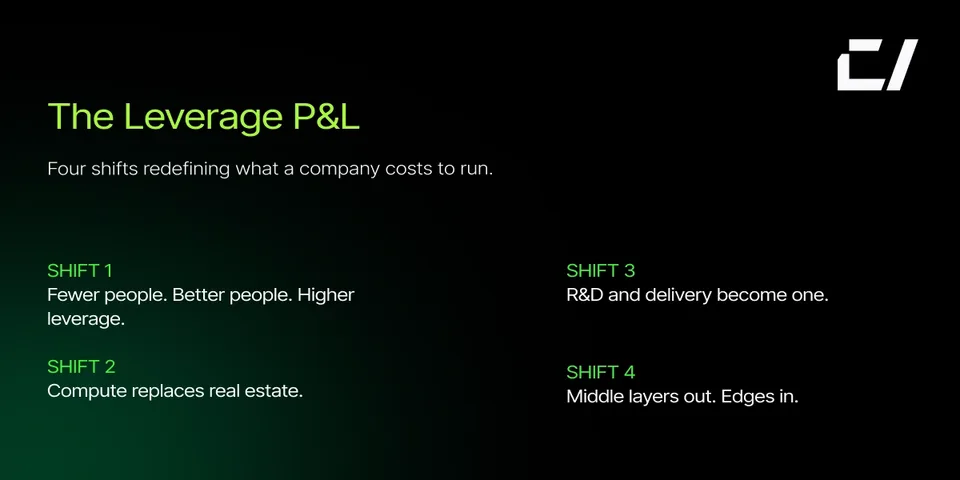
This is answered from lived experience, not theory. What we see at Chartered Vectorial every month is what we call the Leverage P&L, defined by four structural shifts.
Chartered Vectorial has seven people. Five product lines. Active clients across Singapore, Japan, and Thailand. Work that would have required 30 to 40 people at a traditional consulting firm.
Shift 1: Fewer people, better people, higher leverage. Headcount compresses by 60 to 70 per cent. But per-person compensation goes up, not down. Forward Deployment Engineers are not just coders or just consultants. They are both. The metric that matters is revenue per employee and gross margin per engagement, not total headcount.
Shift 2: Compute replaces real estate as a primary cost centre. In a traditional company, the biggest costs are people and real estate. In an AI-native company, it is people and compute: API costs, model usage, GPU infrastructure. And compute is variable cost. It scales with demand, not with hiring cycles.
Shift 3: The R&D and delivery boundary dissolves. In a traditional consultancy, building IP and delivering to clients are separate functions. In our model, they are the same people. Every client engagement improves the platform through the 3Cs. We are not building custom projects. We are configuring a platform.
Shift 4: Middle layers disappear, edges strengthen. What goes away: middle management, dedicated QA, most administrative overhead, traditional analyst roles. What stays or grows: strategic thinkers who frame problems, relationship managers who build client trust, domain experts who validate AI outputs, engineers who build and deploy rapidly.
Companies that adopt AI are retrofitting a jet engine onto a horse cart. The ones that will thrive were born AI-native or are willing to rebuild from scratch. Fewer people. Better people. Higher leverage.
"What is the next frontier of AI that founders should be preparing for today?"
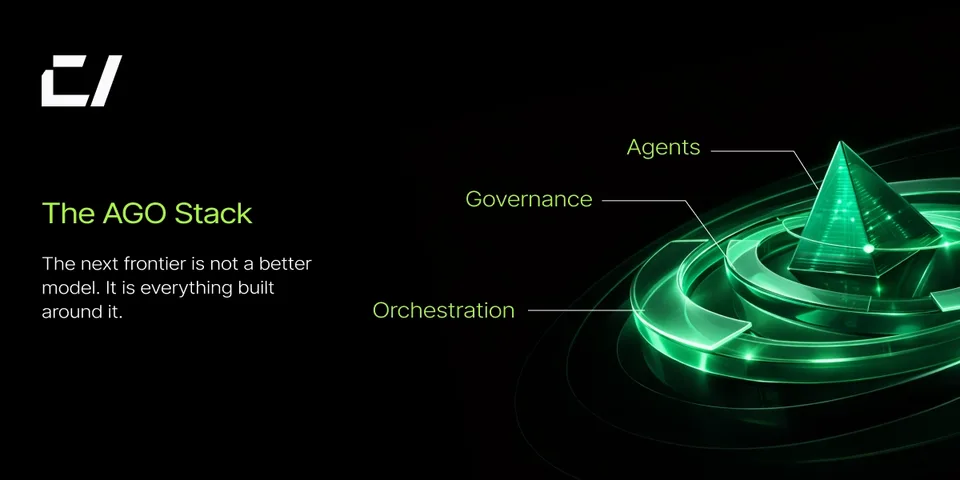
Three frontiers. The acronym makes them easy to remember. We call it the AGO Stack: Agents, Governance, Orchestration.
Agents. Not chatbots. Not copilots. Autonomous agents that execute multi-step workflows without human intervention at every step. The shift from AI that suggests to AI that does is the defining transition of the next 12 to 18 months. Our agent orchestration layer is being subsumed into VectorOS as the core execution engine. Founders still thinking about AI as a chat interface are already behind.
Governance as competitive advantage. By 2027, regulation will have caught up. At least in Singapore, the EU, and parts of Asia. The companies with governance baked in from day one: data lineage, model explainability, audit trails, will win enterprise contracts. VectorShield exists because we saw this coming. Five layers of trust architecture, embedded from day one. Governance is not a compliance burden. It is a sales advantage.
Orchestration. The era of one model doing everything is ending. The next frontier is compound AI systems: specialised models, knowledge graphs, retrieval systems, and business logic working in concert. The VectorEdge Suite is exactly this. Not a single product but an orchestrated intelligence layer. The companies that will dominate 2027 are building the orchestration scaffolding today.
The meta-point: the next frontier is not a better model. It is the scaffolding: agents, governance, orchestration, that makes models actually useful in production.
The Through-Line
Intelligence has been commoditised. The model is available to everyone. What separates the companies that will thrive from the ones that will struggle is not which AI they use. It is how deeply the operating model has been redesigned around the assumption that intelligence is infrastructure.
The old model sold time. The new model sells leverage. And strategy that does not ship is not strategy. It is theatre.
Chartered Vectorial is an AI-native Applied Intelligence company with Consulting DNA, part of the Chartered Group's 35-year legacy of building businesses across Europe and Asia. We ship production-grade AI, configured to your workflows, governed from day one.
Get in touch at info@charteredvectorial.ai